The short answer
Go to the analyzer, drop in your resume (PDF, Word, a photo or text, up to 5 pages) and click Check my resume. In about 30 to 60 seconds you get a score out of 100, ATS parsing checks, a ranked action plan, line-by-line rewrites and a keyword radar. Fix critical issues and the top of the action plan first, then upload the new version to re-check.
01What the analyzer checks
Most employers run applications through an applicant tracking system (ATS) before a person reads them. If the system cannot find your job titles, dates or contact details, a strong resume can look weak. The analyzer shows you what that software is likely to see, and what a recruiter will think once it gets through.
It reads your actual file, not a copy you paste into a form. That means it can measure things like margins, font sizes, column layout and date formats, alongside the content: impact, keywords, language and structure.
02Step 1: Upload your resume
- 1
Open the analyzer
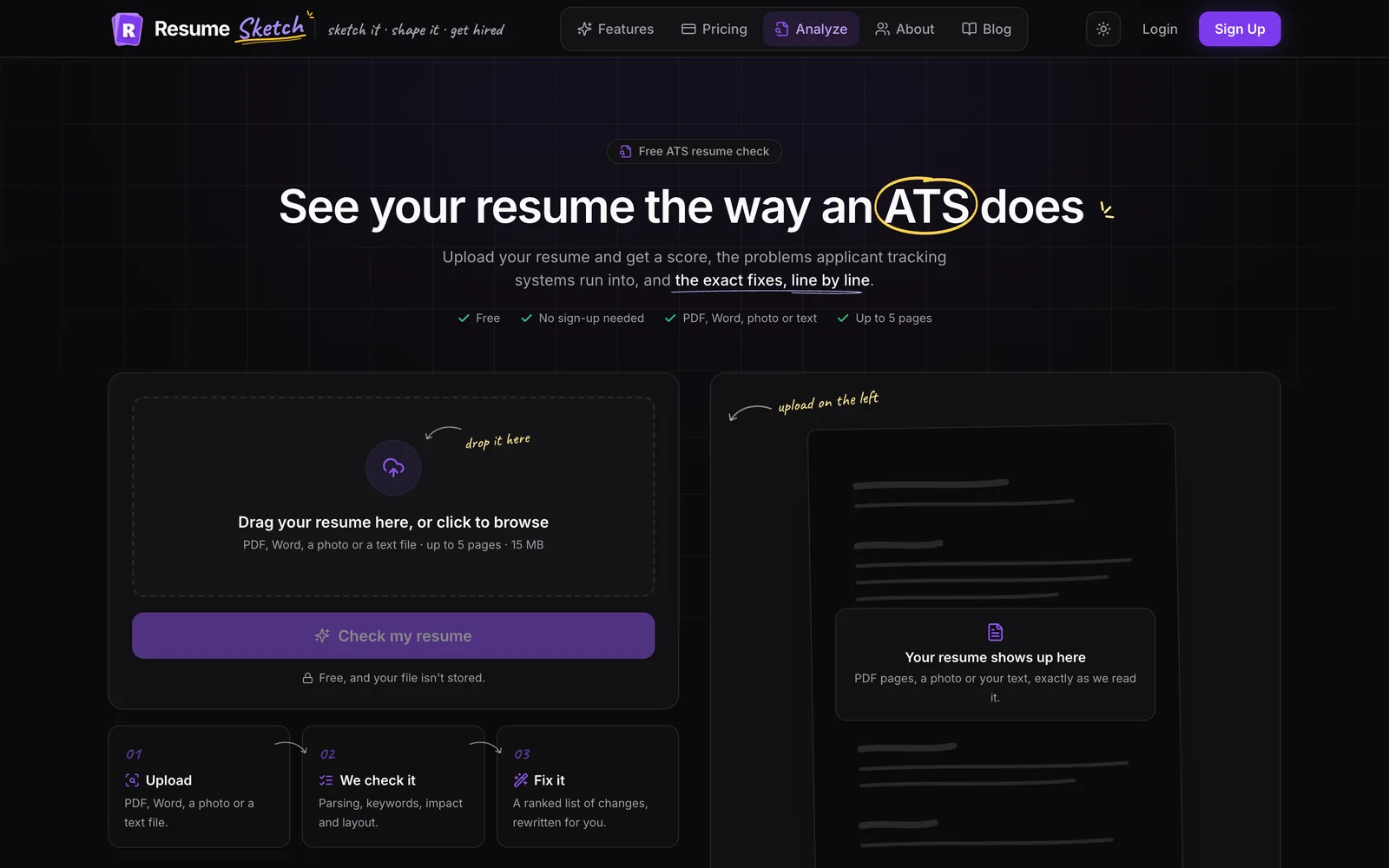
Go to the ATS analyzer.
- 2
Add your file
Drag your resume onto the upload area, or click it to browse. It accepts PDF, Word, a photo or a text file, up to 5 pages and 15 MB. A preview of your document appears once it has been read.
- 3
Click Check my resume
The button turns into a live percentage while the analysis runs.
03Step 2: What the progress steps mean
A typical analysis takes about 30 to 60 seconds. The page shows a percentage and four stages so you know it is moving.
| Stage | What is happening |
|---|---|
| Reading the layout and sections | Finding your headings, sections, dates and job titles, and checking contact details. |
| Checking how an ATS parses it | Testing how parsing software reads each line, including column order and special formatting. |
| Measuring keywords and impact | Comparing your terms with what your detected role usually needs, and looking for numbers and results in your bullets. |
| Writing your fixes | Drafting rewrites for weak lines and ranking every fix by impact. |
Long or scanned documents take longer, sometimes up to two minutes. Keep the tab open until the report appears.
04Step 3: Read the report, section by section
Executive Summary
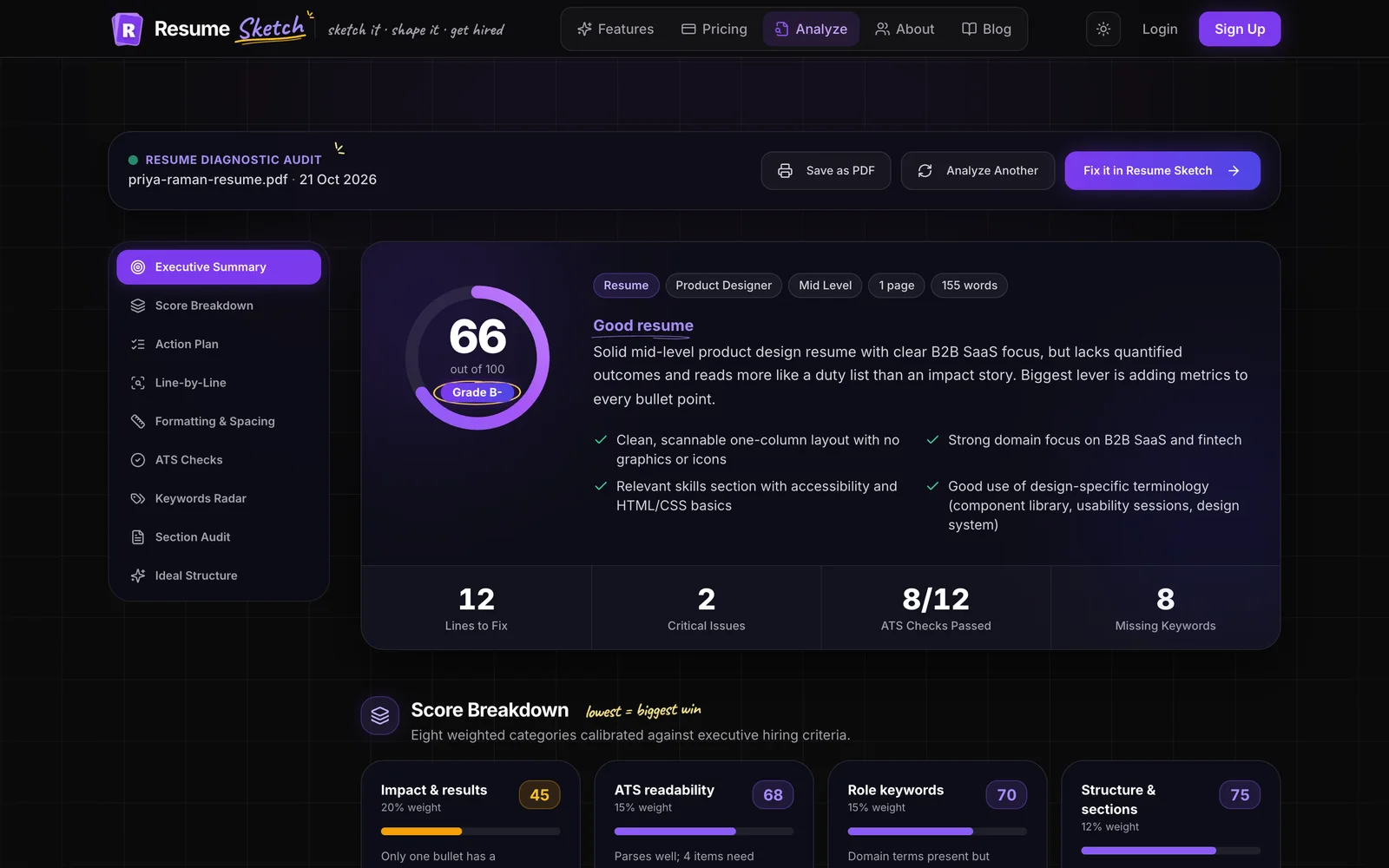
Your overall score out of 100, a letter grade, and a one-word verdict: Strong (80 and up), Good (65 to 79), Needs work (45 to 64) or Weak (below 45). It also shows the role and seniority it detected, a short verdict, your strengths, and four counters: Lines to Fix, Critical Issues, ATS Checks Passed and Missing Keywords.
Score Breakdown
| Category | What it measures | Weight |
|---|---|---|
| Impact & results | Achievements and outcomes instead of duties | 20% |
| ATS readability | How reliably tracking systems can parse it | 15% |
| Role keywords | Coverage of the skills and terms recruiters search for | 15% |
| Structure & sections | Section choice, order and completeness | 12% |
| Formatting & spacing | Fonts, alignment, white space and consistency | 12% |
| Language & clarity | Verbs, concision, tense, grammar and tone | 10% |
| Contact & essentials | Contact details, links, dates and locations | 8% |
| Length & density | Page count and use of space | 8% |
Action Plan
Your fixes in priority order, each tagged as a Quick fix, Moderate effort or Deeper rewrite. Start at number one.
Line-by-Line Review
Specific bullets that need work, shown as written next to a rewrite, with a severity (Critical, Major or Minor), the issue type (such as weak verb, no result or passive voice) and a short note on why it matters. You can copy a rewrite in one click. Anything in [brackets] is a placeholder for your real number.
Formatting & Spacing
Measured from your file: page size, page count, body font size (10 to 12pt reads best), margins, line spacing, single or two-column layout, bullet styles and date formats. Two-column layouts are flagged because some ATS read them out of order.
ATS Parsing Checks, Keywords Radar and the rest
- ATS Parsing Checks: each check marked as passed, warning or critical.
- Keywords Radar: terms Found in Your Document, terms Missing (Add where true), and Overused or Clichéd terms.
- Section-by-Section Audit: what each section does well and what is missing.
- Ideal Document Structure: the recommended order and layout for your kind of document.
05Step 4: Fix the top issues in the right order
Do not try to fix everything at once. Work in this order, because each step makes the next one count for more.
- Critical ATS failures. If the system cannot read your name, email, titles or dates, nothing else matters yet. Usually the fix is a simpler, single-column layout.
- The top three items in the Action Plan. They are ranked by impact for a reason.
- Line-by-Line rewrites. Copy the ones you like, then replace every placeholder with a real figure or delete it.
- Missing keywords that are true for you. Work them into bullets where you actually used the skill, not into a list at the bottom.
- Formatting. Consistent dates, one bullet style, sensible margins.
As written
- Was responsible for social media accounts.
Rewrite
- Ran Instagram and LinkedIn for three product lines, growing followers [X]% in [Y] months with a weekly content calendar.
The fastest way to apply fixes is in Resume Sketch itself. Use Fix it in Resume Sketch at the top of the report, then create a resume by importing your file. Pick a single-column template marked ATS-safe so the layout parses cleanly, and the Ask AI panel can apply rewrites for you.
06Step 5: Re-check your resume
- 1
Download the new version
Export the updated PDF, the same file you will send.
- 2
Run it again
Click Analyze Another on the report, or reload the analyzer, and upload the new file.
- 3
Compare like with like
The analyzer gives the same document the same score, so a change in your score reflects a real change in the resume, not luck.
Want to keep a report? Save as PDF at the top prints it to a file.
Inside the editor there is also a Score panel. It reviews the resume you are editing against your target job, with a breakdown for completeness, impact and role match, a list of top fixes and a Fix with AI button next to each one. Use the analyzer to test the final file, and the Score panel while you are writing.
07Common mistakes
- Chasing 100. A score is a guide. A clear, honest resume in the Good or Strong range that matches the job will do more for you than a few extra points.
- Ignoring the detected role. If it is wrong, recruiters may misread you too.
- Keeping placeholders. Never send a resume with [X]% still in it.
- Analyzing the wrong file. Test the exact PDF you upload to job sites.
- Fixing formatting before content. A tidy resume of duties still reads as duties.
Frequently asked questions
Is the ATS analyzer really free?
Yes. It is free with or without a Resume Sketch account. Usage is rate-limited to keep it fair for everyone.
Which file types does it accept?
PDF, Word, a photo or a text file, up to 5 pages and 15 MB. Scanned documents work but take a little longer.
How long does the analysis take?
Usually about 30 to 60 seconds. Long or scanned documents can take up to two minutes. Keep the tab open while it runs.
Is my resume stored?
No. The analyzer reads your file to produce the report; the file itself is not stored.
What is a good score?
80 and above is labelled Strong and 65 to 79 Good. Rather than chasing a number, focus on clearing critical issues and the top of the action plan, then re-check.
Why did my score not change after a small edit?
Scores move in steps, and small wording changes may not shift a category. Fixes from the top of the action plan, or clearing a critical ATS issue, have the biggest effect.