
The short answer
A strong resume summary is 2 to 4 sentences that say who you are professionally, what you are especially good at, one or two pieces of proof, and what you bring to the role you want. Use one when your story needs framing (career change, senior role, broad experience) and tailor it to each job. Skip it only if it would just repeat your job title.
On this page
- 01The short answer
- 02What a resume summary is for (and when to skip it)
- 03The four-part formula for a strong summary
- 04Weak vs strong: what the difference looks like
- 0514 resume summary examples by role and career stage
- 06Tailor your summary to every job
- 07How to draft and refine your summary with AI
- 08Common summary mistakes to avoid
- 09FAQ
01What a resume summary is for (and when to skip it)
The summary is the short paragraph under your name. A recruiter usually reads it first, often before deciding how carefully to read the rest. Its job is not to list everything you have done. Its job is to frame the page: this is who I am, this is what I am good at, and this is why I fit this role.
That framing matters most when the reader can't work it out from your job titles alone. A summary is worth writing when:
- You are changing careers and need to connect old experience to a new field.
- You are senior and want to lead with scope (teams, budgets, markets) rather than a long list of roles.
- Your experience is broad or unusual, and you want to point the reader at the part that matters for this job.
- You are applying through job boards and recruiters who scan many resumes for the same role.
- You are early in your career and want to highlight skills and direction rather than a thin work history.
You can reasonably leave it out when your resume is already one tight page, your most recent title matches the job exactly, and a summary would only restate it. A weak summary is worse than none, because it spends the most valuable space on the page saying nothing.
02The four-part formula for a strong summary
Almost every summary that works follows the same shape. You don't need all four parts every time, but checking your draft against them is the quickest way to find what is missing.
| Part | What it answers | Example |
|---|---|---|
| 1. Identity and level | Who are you, professionally? | Senior backend engineer with eight years in payments |
| 2. Specialism or strengths | What are you unusually good at? | specialising in high-volume APIs and reliability |
| 3. Proof | Why should I believe it? | Led the migration that cut checkout errors by half |
| 4. Value for this role | What will you do for us? | Looking to bring that focus on dependable systems to a growing fintech team |
A few rules make the formula work in practice:
- Write in implied first person. Drop “I” and “my” (“Product designer with…”, not “I am a product designer who…”). It reads tighter and is the convention in most markets.
- Use the words in the job ad. If the posting says “customer success”, don't call it “client happiness”. Matching terms helps both keyword filters and human skimmers.
- Make proof specific. A number, a named outcome, a scale (“a 40-person team”, “three product launches”). Only use figures you can explain in an interview.
- Cut adjectives you can't prove. “Passionate”, “results-driven” and “hard-working” are claims. Replace them with the evidence that would make a reader think those things on their own.
03Weak vs strong: what the difference looks like
Here is the same marketing manager written two ways. The left version could belong to anyone. The right version could only belong to one person.
Weak
- Results-driven marketing professional with a passion for growth.
- Excellent communication and teamwork skills.
- Seeking a challenging role where I can use my skills and grow.
- Proven track record of success in fast-paced environments.
Strong
- B2B marketing manager with six years in SaaS demand generation.
- Builds paid search and lifecycle email programmes that feed sales, not just traffic.
- Rebuilt the lead scoring model at a Series B company, roughly doubling sales-accepted leads in two quarters.
- Ready to own pipeline targets for a product-led growth team.
Notice what changed: a real level and field instead of a label, a named specialism instead of soft skills, one concrete result instead of “proven track record”, and a closing line that points at the job.
0414 resume summary examples by role and career stage
Use these as patterns, not scripts. Swap in your own field, strengths and proof. The figures below are illustrative; yours should come from your own work.
Students, graduates and early career
- Computer science graduate: Computer science graduate with internship experience building internal tools in Python and React. Shipped a scheduling feature used by the operations team daily and maintain an open-source CLI with active contributors. Looking for a first full-time role on a product engineering team.
- Marketing graduate: Marketing graduate with hands-on social and content experience from two internships and a student society role. Grew the society's Instagram audience and ran its first paid event campaign on a small budget. Eager to bring practical content skills to an in-house brand team.
- Junior accountant: Junior accountant with two years in a mid-sized audit practice, working on month-end close, reconciliations and statutory accounts for SME clients. Part-qualified and studying towards full qualification. Known for clean working papers and catching reconciliation issues early.
- Customer support (first promotion): Customer support specialist with three years in SaaS, now leading onboarding for new enterprise accounts. Wrote the help-centre articles that became the team's standard first response. Ready to step into a customer success role.
Mid-level professionals
- Registered nurse: Registered nurse with five years in acute medical and critical care settings. Experienced in sepsis recognition, patient education and mentoring newly qualified staff. Calm under pressure and committed to safe, evidence-based care on busy wards.
- Data analyst: Data analyst with four years turning messy operational data into decisions for retail and logistics teams. Strong in SQL, Python and dashboard design. Built the weekly stock-availability report that regional managers now use to plan orders.
- Product designer: Product designer with five years across mobile and web, focused on onboarding and checkout flows. Runs lightweight research and turns it into tested prototypes quickly. Redesigned a sign-up flow that measurably reduced drop-off in its first release.
- Teacher: Secondary science teacher with seven years teaching chemistry and physics across all ability levels. Leads the department's practical-skills programme and supports trainee teachers. Committed to clear explanations and steady progress for every student.
- Sales executive: Account executive with five years selling HR software to mid-market companies. Consistently at or above quota, with a focus on multi-stakeholder deals and long-term renewals. Looking to move into strategic accounts.
Senior and leadership roles
- Engineering manager: Engineering manager leading three teams across platform and payments. Grew the group from 9 to 22 engineers while keeping delivery predictable and attrition low. Strong believer in clear ownership, written decisions and coaching new leads.
- Finance director: Chartered accountant and finance director with 15 years in manufacturing and distribution. Led two ERP implementations and a refinancing, and built the FP&A function from scratch. Partners closely with operations to turn forecasts into decisions.
- Operations head: Operations leader with twelve years running warehouses and last-mile delivery across multiple regions. Known for standardising processes that improve on-time delivery without adding headcount. Seeking a head of operations role in a scaling e-commerce business.
Career changers and returners
- Teacher to instructional designer: Former teacher moving into instructional design, with ten years planning curricula and assessing learning outcomes. Recently built three e-learning modules in Articulate Rise for a nonprofit and completed a certificate in learning design. Brings a classroom-tested sense of what helps adults actually learn.
- Returning to work: Project coordinator returning after a three-year career break, with six prior years delivering office moves and IT rollouts for a professional services firm. Recently refreshed skills with a project management certification. Organised, steady and ready to own schedules and stakeholders again.
05Tailor your summary to every job
The summary is the easiest part of a resume to tailor, and the part where tailoring shows most. You rarely need to rewrite your experience for each application, but adjusting two or three phrases in the summary can make the whole page feel written for the role.
- 1
Find the two or three things the job cares about most
Look at the first lines of the posting and the requirements that repeat. Those are your priorities.
- 2
Lead with the matching strength
If the ad emphasises stakeholder management, move that ahead of technical depth. Same facts, different order.
- 3
Mirror their language honestly
Use the posting's terms for skills you genuinely have. For more on this, see resume keywords that get you hired.
- 4
Swap the closing line
End with what you would bring to this team, sector or stage of company.
In Resume Sketch, the cleanest way to manage this is one resume per type of role, each created from your profile, with a target job added in the editor so AI suggestions follow that posting. The tailoring guide walks through it.
06How to draft and refine your summary with AI
AI is genuinely useful here, because a summary is a compression problem: it has to pull the most relevant parts of your whole resume into a few lines. Resume Sketch gives you two ways to do it, and both work from what is already on your resume rather than inventing a background for you.
- 1
Fill in your experience first
The AI writes from your resume, so a summary drafted before your experience section is complete will be thin. Use Fill from profile in Personal details if you keep your history in your profile.
- 2
Add a target job
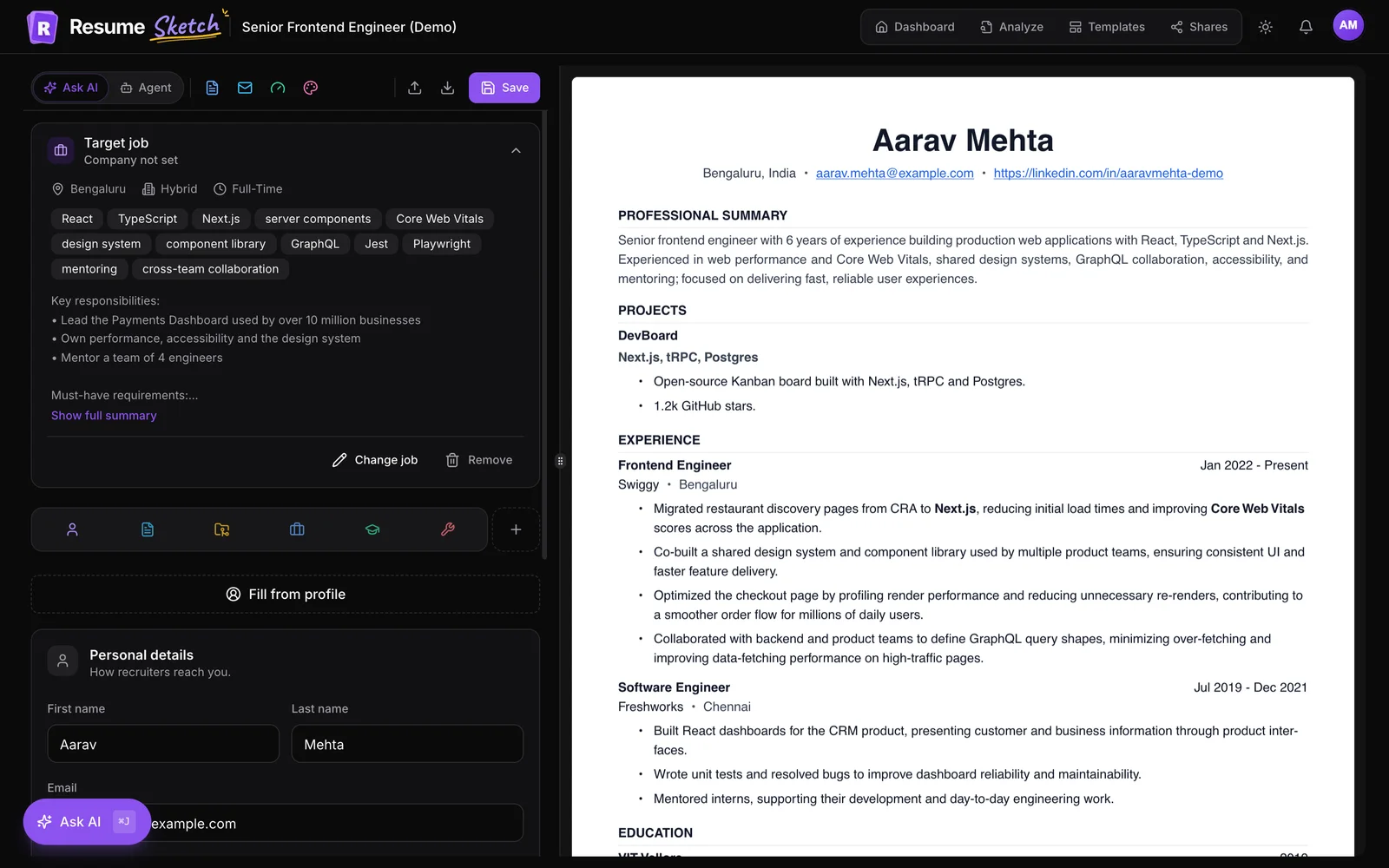
Open the Target job card at the top of the editor and paste the job description. Summary suggestions then focus on that role.
- 3
Use the summary section's AI button
In the Summary section, choose Write with AI (or Improve if you already have one). You can add instructions or pick a preset such as Shorter, More confident, Focus on the target role or Career change angle. You get three options to choose from, and nothing changes until you pick one.
- 4
Refine it in conversation with Ask AI
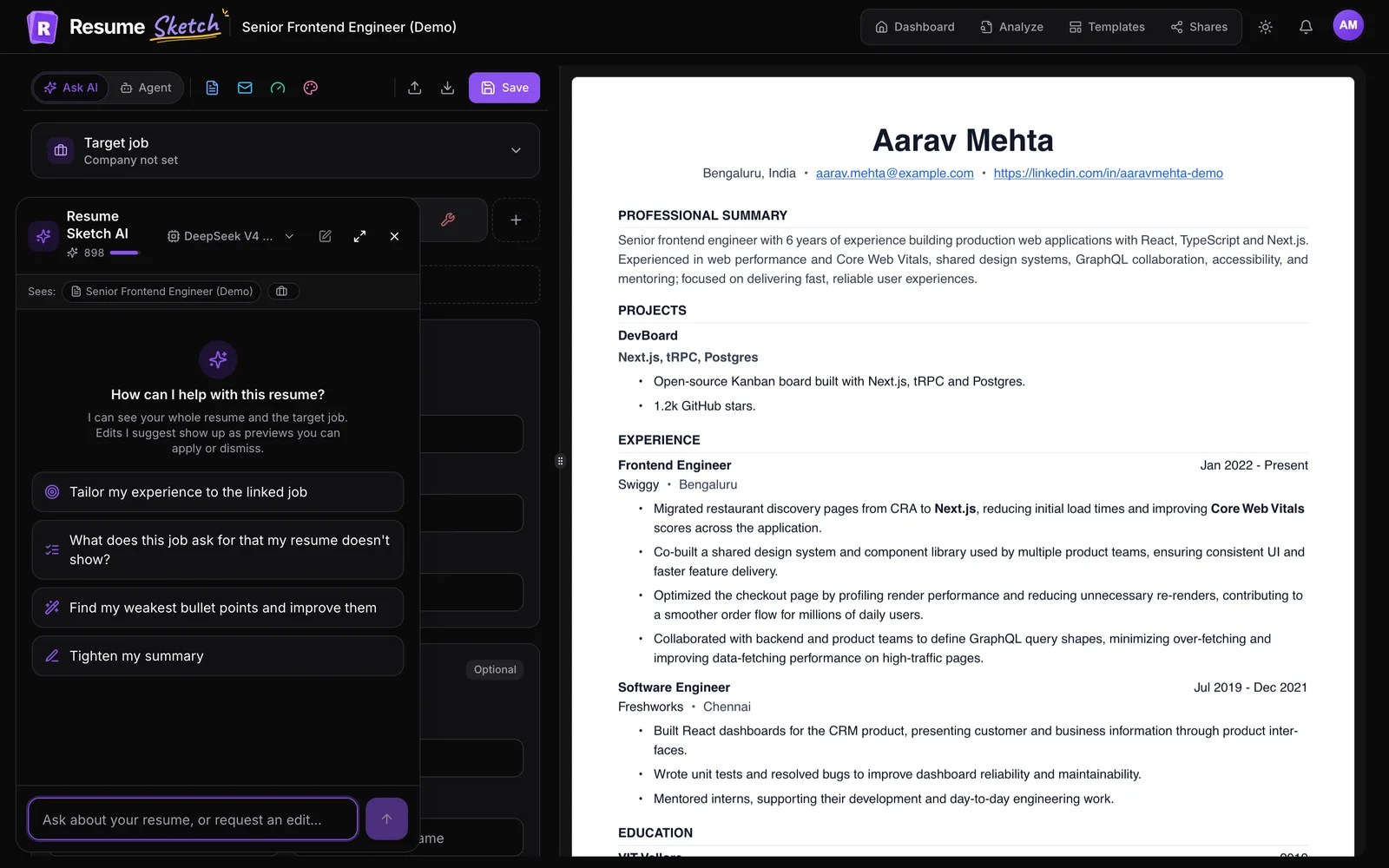
Open Ask AI (⌘J on Mac, Ctrl+J on Windows) for back-and-forth edits: “Write a professional summary for me”, “Tighten my summary”, or something specific like “Lead with my payments experience and cut it to three sentences”. Suggested edits appear as previews you can apply or dismiss.
- 5
Make the final pass yourself
Check every claim is true, every number is one you can explain, and the voice sounds like you. Then read it next to the job ad one last time.
07Common summary mistakes to avoid
- Writing a paragraph of adjectives. If you deleted every adjective, would anything be left? If not, start again from the formula.
- Going long. Past about four sentences, a summary turns into a cover letter. The word counter under the summary in the editor warns you once you pass about 90 words.
- Repeating your first bullet point. The summary should frame your experience, not duplicate it.
- Using one summary for every application. A generic summary is the clearest sign of a generic application.
- Claiming things you can't back up. Interviewers often start with your summary. Every line is a question you may be asked.
- Third person. “Jane is a dedicated…” reads like a bio, not a resume.
Frequently asked questions
How long should a resume summary be?
Two to four sentences, usually somewhere between 40 and 80 words. Long enough to state who you are, your main strength and one piece of proof, short enough to read in a few seconds.
Do I need a summary if I'm a recent graduate?
It often helps, because your work history alone may not show your direction. Keep it short and focus on relevant skills, projects or internships and the kind of role you want. If your resume is already tight and obviously targeted, you can skip it.
Should a resume summary be written in first person?
Use implied first person: leave out “I” and “my” and start with your professional identity, for example “Data analyst with four years in retail.” Avoid third person, which reads like a biography.
What's the difference between a resume summary and a cover letter?
The summary is a few lines that frame your resume. A cover letter is a full letter that explains your interest in a specific company and role and tells a short story about your fit. Resume Sketch can draft both from the same resume and target job.
Can AI write my resume summary for me?
It can write a strong first draft, especially when it can see your experience and the job you are applying for. In Resume Sketch it drafts from what is on your resume and shows you options before anything changes. You should still check every claim and adjust the wording so it sounds like you.